Payroll Process Improvement Ideas You Can Implement
 Michał RejmanChief Marketing Officer at Flobotics
No doubt that following the financially challenging years, we’re all feeling the pinch. Rather than crying over spilled milk, one way your company can save money is to improve, optimize and automate your payroll processes.
If there’s anything you can do now, streamlining internal procedures to guarantee your organization is receiving the most value for money should be at the top of your list. Continue reading for a list of payroll process optimization suggestions to help you handle this aspect of your organization while saving you time and money.
What are the problems that companies face with the payroll?
Payroll generally refers to the procedure for ensuring that your employees are paid on time. But why is it necessary to optimize it?
Common payroll issues
- 01Miscalculated overtime
- 02Misclassified exempt workers
- 03Wrong tax rates
- 04Inaccurate worker classification
- 05Late payroll
Poor payroll systems and badly-design processes might cost your company a lot of money. While manually processing payroll may appear less expensive, coordinating data gathering, such as timesheets, takes time and requires experienced human resources. “Time is money,” as the saying goes.
Manual payroll processing exposes your company to the danger of human mistakes, which may result in many issues. Consider the case where one of your employees, contractors, or business partners isn’t paid on time or receives an inaccurate paycheck. This might breed distrust and lead to losing faith in your company. In addition, this might lead to legal complications, which are always best to avoid in the first place.
That’s why we are writing to you from our experience with all the Payroll Process Improvement Ideas we can propose for your system and business to thrive.
When is the right time to implement one of the payroll process improvement ideas?
You might need to assess several factors to have a solid answer. Here is a bunch of them:
How long ago was your payroll implemented?
With the huge technological developments and the rapid economic changes, you need to consider being up to date with all your systems, especially the payroll one. 3-5 years are more than enough to have a major upgrade in your approach to cope with the internal changes in the company like personnel expansion & regulatory changes. Also, the payroll system should abide by the tax regulations that change every few years.
Have you evaluated whether your payroll software matches your requirements?
We certainly hope you did! Requirements are pretty dynamic and in constant change. That’s why it’s necessary to assess your legal status, personnel number, expansion plans, updated tax regulations, and any changes in the company’s organizational structure and hierarchy that might trigger some changes in the payroll system.
Do your employees have easy access to the payroll system?
Easier said than done! Employees have the right to look at their status within the company at any point in time and have full access to their benefits, salaries, compensations, reimbursements, rewards, etc.… That must be done securely as it’s susceptible and confidential data, so no one should be granted access to such info except for their data only.
Do all employees receive their salaries on the same day?
Some companies have different pay schedules for employees. For example, part-time employees might receive paychecks once a month, whereas full-time workers get paid bi-weekly. Several pay cycles create more administrative work for payroll staff and exposure to possible human error. By synchronizing all pay schedules, the team can spend less time processing paystubs and sending out checks.
Where is payroll automation within your current system?
Automating your current payroll setup, your employees’ salaries will be processed automatically, and any raises or bonuses will automatically be added to monthly wages as soon as a member of management has registered them in the system. An automated & digital system has an additional benefit that we can’t ignore.
Which payroll process improvement ideas should you consider?
1. Automate repetitive payroll tasks with RPA
RPA bots do the rule-based steps a person does on screen: updating payroll records after a raise or a reimbursement, checking time entries, loading earning and deduction batches, and year-end reconciliation. RPA doesn’t replace your payroll engine; it takes over the manual work around it.
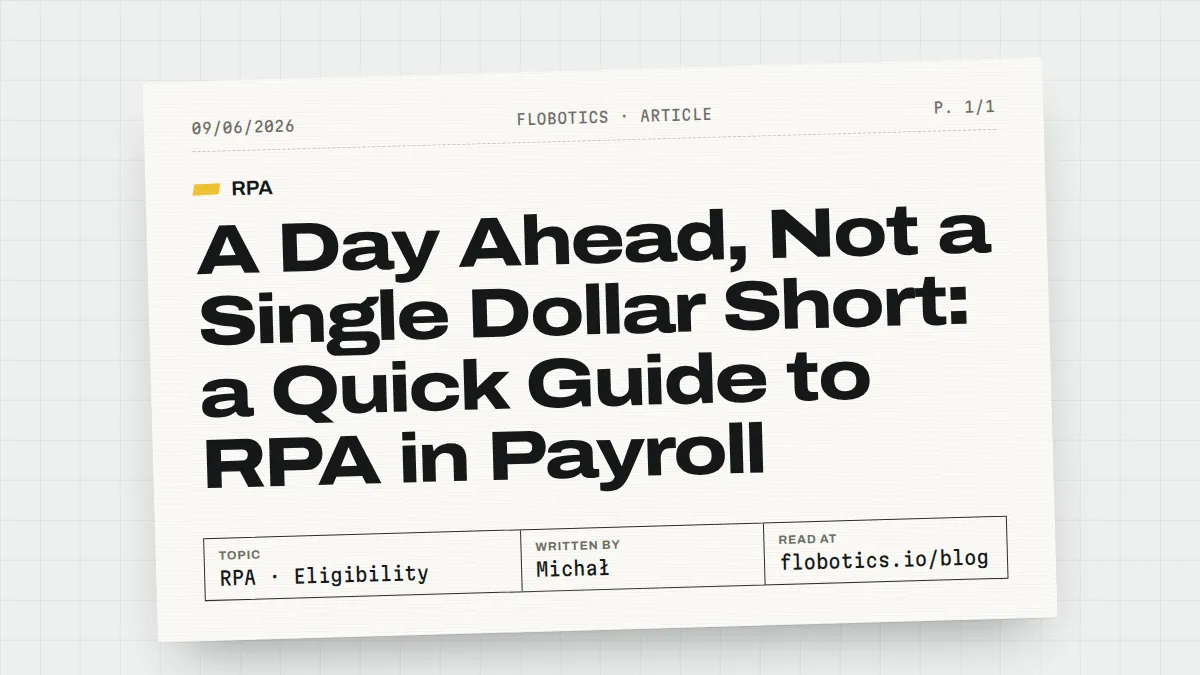
We cover this idea in detail, with the payroll tasks worth automating first and examples from Lenovo, BAE Systems and Global Upside, in our guide to RPA in payroll.
2. Payroll Integration with external Systems
Integrating your payroll processing system with time and attendance monitoring software is another way to improve its efficacy if you automate your complete payroll processing system.
Employee time and attendance monitoring software, if you don’t already have it, helps you save money on labor by recording the amount of time your employees spend doing their jobs so you don’t have to.
This software can replace manual data input with data collecting via devices like geofencing-enabled mobile applications, real-time reporting that syncs employee data in real-time, biometric authentication, and contactless punches.
You can process monthly salaries faster and more precisely if you integrate your payroll system with this software and bring the two together in one platform. You’ll also be able to utilize data analytics to evaluate staff productivity and determine exactly what tasks your employees are working on.
3. Stay up-to-date
Another way to improve payroll services and automation once you’ve automated your payroll process is to ensure you’re using the most recent version of the software. When programs need an update, they might start to operate slowly, so be sure you’re not wasting any time (and hence money) by doing so.
If your payroll operations were previously automated, now is the time to upgrade to the most recent version of your program. Updates can also guarantee that applications work as efficiently as possible.
4. 24/7Access For Workers
One of the most significant things your software may have when it comes to payroll process optimization ideas is the ability for employees to access and update the system at any time of day. For entering information regarding sick days, vacation days, and — if your payroll software is linked to time and attendance monitoring — when workers are clocking in and out — a cloud-based payroll system that anyone can access is critical.
Your employees will notice more openness, which helps develop a sense of trust between management and employees.
5. Provide a Great User Experience
With the above in mind, your employees must have a simple time navigating the payroll software. Nothing is more frustrating than a complicated system that is difficult to navigate for staff unfamiliar with the program. This will waste time for your HR department, which controls the software, and your employees, who have more vital responsibilities.
If the payroll technology is going to be challenging for employees who aren’t as tech-savvy, be sure to draw up instructions on how to use the step-by-step payroll process and share them internally via communication channels. You might even arrange payroll software training classes, which you could refresh every few months or so as technology advances.
6. Make Your System Transparent
Is your system simple enough for all staff to use? Transparency is at the heart of the finest payroll improvement solutions. Make a concerted effort to arrange regular meetings to inform employees about all corporate regulations influencing payroll. Develop written resources detailing the knowledge for simple reference in addition to training. It’s also a good idea to put the documents on display around the office.
7. Constant Review
Last on our list of payroll process improvement ideas is to evaluate your payroll software regularly to ensure that it is compliant with state and federal tax laws.
While keeping up with regulatory changes is a best practice in payroll processing, items can easily slide between the cracks. And, because laws are continually changing, your company might face legal action if it fails to comply with payroll tax obligations before you know it.
Some payroll software will automatically update to reflect any legal changes, but if yours does not, be sure the team in charge of keeping it up to date is. Failure to comply might be a costly blunder for your company.
Payroll processing, step by step, and how to improve it
- 01Collect employee tax informationImprove: automate data entry with RPA.
- 02Manage recordsContracts, tax forms, handbooks, training. Improve: automate data entry with RPA.
- 03Set pay schedulesImprove: connect time monitoring software.
- 04Track time and attendanceImprove: connect time and attendance software.
- 05Calculate deductionsImprove: automate the calculation with RPA.
- 06Pay employeesImprove: connect payroll providers.
- 07Submit payroll tax paymentsImprove: automate tax calculations with RPA. Also: keep software up to date, give 24/7 access, write playbooks and review compliance regularly.
Looking for RPA opportunities in other industries? See what benefits can automation in e-commerce bring to your company.
Conclusion
Payroll’s job is going to become more ‘human’ than it has ever been. Teams from payroll will be on hand to share insight, engage, and enlighten coworkers. At the same time, technology such as RPA will handle the monotonous and administrative duties that currently consume their time.
From our perspective, payroll has had to be one of the most adaptable departments for change. As a professional, you’re always forced to comprehend and apply new laws under tight timelines and communicate them to workers and business stakeholders in relevant ways. In a world of rising automation and robotics, the analytical and communication skills required in this process are – and will continue to be – vital, offering a ‘human’ touch.
As more payroll teams see the importance of RPA, I believe we’ll see a movement in the role payroll plays within an organization and a shift in views regarding payroll as a critical function that may provide strategic information. You can also learn about SAP automation opportunities for your company.
Thinking about improving your payroll processes with automation? Feel free to reach out to us for any support needed! Build simple trial automation with our RPA consultants to try the RPA out.
Chief Marketing Officer at Flobotics. More from Michał
Show us the process your team is tired of doing manually.
Let Karl, our CTO, take a look. It’s 30 minutes with the person who designs the automations, not a sales script.

Walk me through the process your team does by hand. I’ll tell you whether it’s worth automating and how I’d approach it.
Karl